
Aincan Dynamic Sync Indicator: 9 Powerful Trading Secrets
The Aincan Dynamic Sync indicator is completely revolutionizing how modern technical analysts interact with market momentum. For decades, retail traders have relied on static oscillators that were originally developed in the 1970s. While tools like the Relative Strength Index (RSI) or the MACD were groundbreaking for their time, modern financial markets are driven by high-frequency trading algorithms, massive dark pool liquidity, and unprecedented volatility. Using outdated tools in a modern market often results in false signals, premature entries, and frustrating drawdowns.
This is exactly where the Aincan Dynamic Sync indicator steps in to bridge this massive technical gap. By calculating momentum through a dynamic, adaptive lens rather than relying on a static mathematical formula, it provides a significantly clearer picture of what institutional buyers and sellers are actually doing behind the scenes. In this comprehensive, deep-dive guide, we will unpack the complex mechanics of this tool, how to interpret its visual data accurately, and the precise strategies you need to extract consistent profits from the markets.
The Problem with Traditional Oscillators
Before we dive into the specific mechanics of the Aincan Dynamic Sync indicator, we must understand why a completely new approach to momentum analysis is necessary. Traditional oscillators operate on fixed boundaries. For example, the classic RSI uses a static 70 level to indicate “overbought” conditions and a 30 level to indicate “oversold” conditions. However, in a strong, aggressively trending market, the price can remain in the “overbought” territory for weeks. Traders who blindly sell when the normal indicator hits 70 end up getting liquidated as the trend continues to surge upward relentlessly.
Static indicators simply do not understand the current market context. They do not expand when volatility increases sharply, nor do they contract when the market goes quiet and enters a consolidation phase. This fundamental flaw forces traders to constantly tweak their settings—changing lookback periods from 14 to 21, or adjusting boundaries—in a desperate attempt to optimize for the current market phase. This leads to curve-fitting and inevitable failure. This is exactly where the Aincan Dynamic Sync indicator shines as the ultimate solution.
What is the Aincan Dynamic Sync indicator?
The Aincan Dynamic Sync indicator solves the static boundary problem by introducing intelligent, highly adaptive baselines. Instead of drawing a straight, unmoving line at a specific value, this advanced indicator plots dynamic, stepped bands that actively calculate the true mathematical extremes of the current volatility cycle. These faint, stair-stepping lines wrap around the central oscillator, providing a flexible barrier that adapts to liquidity flow.
When the market is consolidating and moving sideways in a tight range, these dynamic bands contract, bringing the overbought and oversold thresholds much closer to the median. This allows the Aincan Dynamic Sync indicator to catch smaller, valid reversals that a static oscillator would completely ignore. Conversely, when a major news event drops and the market explodes into a massive trend, the dynamic bands expand outward. This expansion prevents the indicator from giving you a premature reversal signal, keeping you safe from trading against a macroeconomic tidal wave.
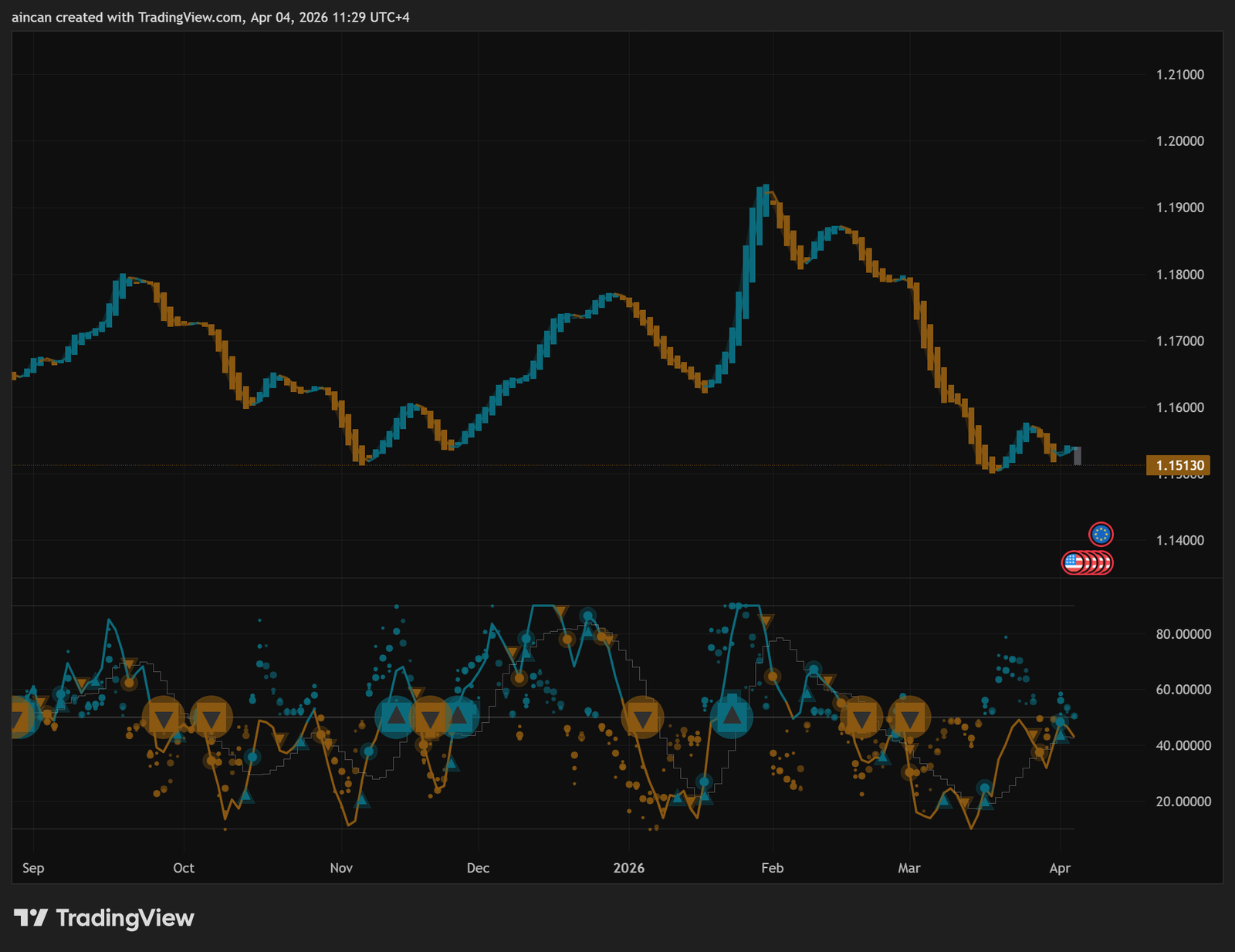
The Anatomy of the Oscillator: Visual Decoding
To the untrained eye, advanced trading tools can look like a confusing array of colors and shapes. However, once you learn the visual language of the Aincan Dynamic Sync indicator, reading market momentum becomes as intuitive as reading a traffic light. Let’s break down the core components of this tool:
- The Color-Shifting Main Line: The primary oscillator line fluctuates between 0 and 100. More importantly, it changes color based on the immediate micro-trend. A teal (blue-green) line indicates that buyers have the upper hand and momentum is positive. An orange or brownish line signifies that sellers have taken control and momentum is negative.
- The Stepped Volatility Bands: These are the adaptive overbought and oversold zones we discussed earlier. You will notice they look like faint staircases. A true momentum extreme is only reached when the main colored line pierces completely outside of these stepped bands.
- Momentum Dots: You will frequently see small teal or orange dots appearing along the oscillator. These are early warning signs. They represent an underlying buildup in order flow or a subtle shift in volume that hasn’t fully manifested in the actual price action yet.
- Directional Triangles: These geometric shapes act as immediate directional triggers, confirming that the momentum shift indicated by the dots has now gained sufficient mathematical weight to impact the price.
- The Major Reversal Circles: This is the most powerful signal the Aincan Dynamic Sync indicator produces. When you see a large highlighted circle (often containing a triangle) at the extreme edges of the oscillator, it marks a highly probable point of total market exhaustion.
Because of its deep data processing requirements, this indicator performs best on robust web-based charting solutions. You can easily integrate this tool and conduct extensive backtesting on platforms like TradingView, which offers the ideal environment for advanced technical analysis.
The Ultimate Buying Strategy
Executing a long position (buying) using the Aincan Dynamic Sync indicator requires patience and strict adherence to the rules. Do not try to anticipate the indicator; wait for it to confirm the setup. Here is the step-by-step framework for a high-probability buy trade:
First, observe the main oscillator line. It should be orange, indicating a downtrend, and it must drop aggressively to pierce the lower dynamic stepped band. This tells you the market is statistically over-extended to the downside. However, do not buy yet. The price could continue to drop.
Second, wait for the exhaustion phase. You want to see the orange line begin to flatten out and start curving upwards. The trigger occurs when the line color shifts from orange to teal. This color flip is your first confirmation that buying pressure is entering the market.
Finally, look for the definitive geometric signal. You want to see a major teal reversal circle print on the oscillator. Wait for the current candlestick on your price chart to fully close. If the candle closes and the circle remains, execute your buy order. Place your stop loss slightly below the most recent swing low to protect against sudden volatility spikes.
The Ultimate Selling Strategy
The strategy for short selling with the Aincan Dynamic Sync indicator is the exact inverse, but it requires equally strict discipline. Retail traders are often eager to short strong rallies, which is a dangerous habit. This tool will protect you from stepping in front of a bullish freight train.
Watch the teal oscillator line as it climbs toward the 100 level. It must break above the upper dynamic stepped band. At this point, the market is severely overbought relative to its recent volatility. Again, do not execute a short trade simply because the line is high.
Wait for the momentum to break. The line must curl downwards and change its color from teal to orange. This color transition proves that the buyers have exhausted their capital and sellers are taking over. When the large orange reversal circle appears and the candle closes, execute your sell order. Your stop loss should be placed just above the recent swing high.
Spotting Hidden Market Divergence
While the geometric shapes provide excellent entry triggers, professional traders use the Aincan Dynamic Sync indicator to spot divergence. Divergence occurs when the price action on your chart disagrees with the momentum reading on the indicator. This disagreement is often the earliest sign of a massive market reversal.
Regular Bullish Divergence: If the price of an asset is making lower lows (dropping), but the oscillator is making higher lows (rising), this means the downward momentum is dying from the inside, even though the price is still falling. This is a powerful signal that a massive upward reversal is imminent.
Regular Bearish Divergence: If the price is making higher highs (climbing), but the oscillator is making lower highs (falling), the buyers are running out of steam. A sharp drop is highly likely on the horizon.
Choosing the Optimal Timeframes
One of the greatest strengths of this tool is its versatility across different trading styles. For day traders and scalpers, applying the indicator to the 5-minute or 15-minute charts provides rapid, intraday signals. However, lower timeframes naturally contain more market noise, so you must be highly selective with your entries.
For swing traders and position traders, the 1-hour, 4-hour, and Daily timeframes are where the Aincan Dynamic Sync indicator truly shines. The signals generated on the 4-hour chart carry significant institutional weight. When you see a major reversal circle on a Daily chart, you are often looking at a macroeconomic turning point that could dictate the trend for weeks or even months.
Capital Protection and Risk Management
It is crucial to understand that no technical analysis tool possesses a 100% win rate. The market is ultimately driven by human emotion and unpredictable global events. Therefore, your survival as a trader depends entirely on your risk management protocols.
When trading with the Aincan Dynamic Sync indicator, you must never risk more than 1% to 2% of your total account equity on a single trade. Furthermore, you should always aim for a minimum Risk-to-Reward ratio of 1:2. By maintaining this ratio, you can actually lose half of your trades and still remain profitable. For a deeper understanding of position sizing, we highly recommend reading our extensive guide on effective money management in trading.
Final Thoughts on Market Mastery
The Aincan Dynamic Sync indicator is not just another line on a chart; it is a comprehensive momentum ecosystem. By replacing rigid, static boundaries with intelligent, adaptive volatility bands, it allows traders to see the true ebbs and flows of institutional capital.
Mastering this tool requires screen time. Open your trading platform, apply the indicator, and spend time scrolling back through historical price data. Study how the color shifts align with price turns, and memorize what the major reversal circles look like. By combining this powerful oscillator with strict risk management, you will position yourself to thrive in the complex financial markets of 2026 and beyond.